
PRACTICAL MENTAL ARCHITECTURE
Build the systems behind how you think, learn and perform.
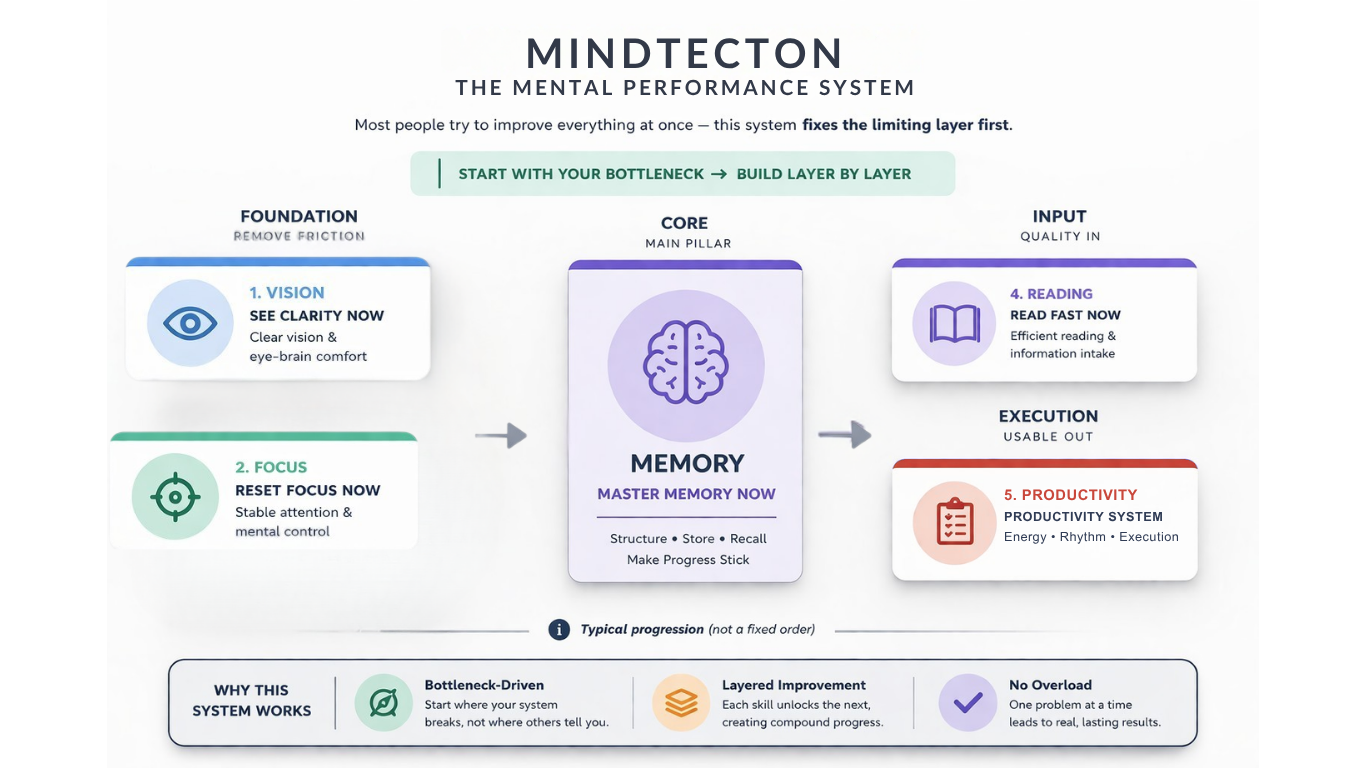
Five connected programs for focus, reading, memory, visual clarity and consistent execution.

Structure Before Force
When the system is weak, pushing harder creates more strain.
Systems Over Willpower
Performance becomes repeatable when the process supports it.
Built for Real Life
Practical tools for demanding work, learning and daily execution.
Five Programs. One Cognitive System.
Begin with your largest bottleneck or explore the entire connected framework.
Reset Focus Now
Stabilise attention, reduce distraction and return to deep work.

Read Fast Now
Improve reading mechanics, comprehension and input speed.
Master Memory Now
Build stronger encoding, association, recall and retention.

See Clarity Now
Reduce visual overload and improve comfortable eye–brain coordination.
Reset Rhythm Now
Create a reliable rhythm for energy, execution and consistency.
One System. Stronger Results.
Latest Insights
-

How to Read Dense Information Without Constantly Restarting
How to Read Dense Information Without Constantly Restarting You reach the end of a technical paragraph and realise that the beginning has already disappeared. You return to the first sentence. The second pass feels more familiar, but the argument still does not hold together. After the third attempt, you have read the same words several…
-

How Posture Can Make Eye Strain Worse
You begin the day sitting comfortably. An hour later, your head has drifted toward the screen, your shoulders are raised, and your face is much closer to the display than when you started. Your eyes feel tired, but the discomfort may not be coming from the eyes alone. Posture can make eye strain worse by…
-

Why Your Performance Problem May Not Be the Problem You Think It Is
A slower report, forgotten explanation, or difficult afternoon may look like a focus problem without starting in attention. Test the task chain and find where performance first breaks down.
Not sure where to begin?
Take the MindTecton assessment and identify the system creating the most friction right now.